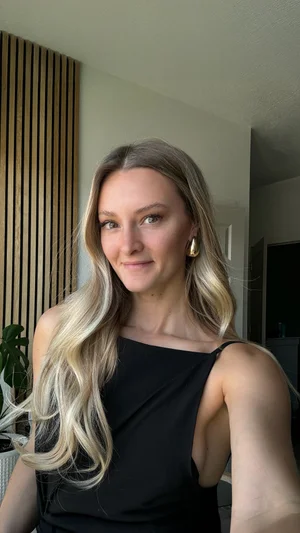
The Manaslu Circuit Trek Almost Broke Me. Here's My Honest Review.
By Karlie Place
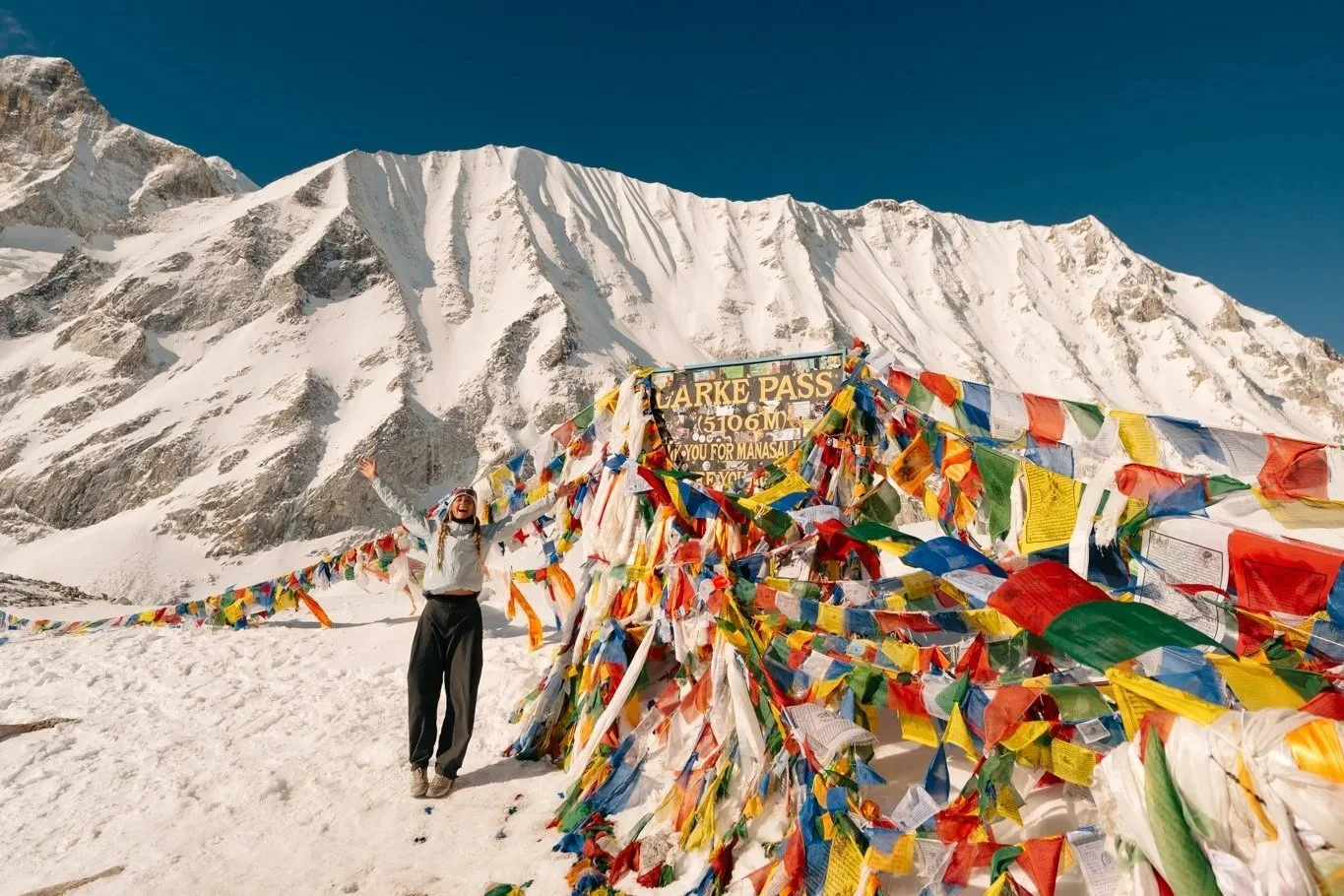
I want to tell you about the morning of May 4, 2026, when I stood at 5,106 meters above sea level, prayer flags whipping over my head, and cried for almost ten minutes straight in front of two Nepali men I barely knew well enough to share a meal with.
I want to tell you about that moment because I want you to understand what I had to do to get there. I broke my $4,000 camera on day two. My travel companion was helicoptered off the trail on day three with a possible rabies exposure. I had mental breakdowns on a high alpine plateau on day five. I lost two toenails. I had a panic attack at 4,460 meters and clawed at my own neck in the dark trying to breathe.
And once I was at the top of Larkya La, none of it mattered.
This is my honest review of the Manaslu Circuit Trek. It is not a balanced tour-operator listicle. It is the story of what this trek actually did to me, told the way it actually felt. If you are trying to decide whether to do this trek, I hope this is the post you needed.
If you want the practical companion pieces to this story, I've written three of them: the full day-by-day itinerary, the photographer's packing list, and the step-by-step booking guide. This post is the why. Those three are the how.
The Quick Verdict
The Manaslu Circuit is one of the most extraordinary, hardest, most spiritually disorienting things I have ever done. It is not a vacation. It is not the bucket-list version of itself. It is the real, raw, no-shortcuts version of the Himalayas, and it cracked me open in a way I am still processing.
I went in unsure of whether I was the kind of person who could do something this hard. I came out knowing.
My Manaslu Circuit by the numbers
87.37
trail miles
23,892
feet climbed
5,106 m
highest point
10
days on the trail
2
toenails lost
∞
prayer flags
Solo female photographer · Trekked April 21 – May 5, 2026 · Booked with Ecuatraveling · Would I do it again? Without question.
Going In Unsure
Before I even left Salt Lake City, I had this quiet voice in my head asking whether I'd actually signed up for too much. I'd been to forty countries. I'd done plenty of hard things. But I had never been to altitude. I had never done a true high-altitude trek. I had never spent ten consecutive days on my feet in the mountains of a country I'd never set foot in.
I picked Manaslu specifically because I didn't want the version of Nepal that has been polished smooth by 60,000 trekkers a year. I'd never had any pull toward Everest. The crowds, the commercialization, the lines for selfies at base camp — that wasn't what I was after. I wanted the trek that still had its dignity. The Manaslu Circuit only sees about 10,000 trekkers a year, and it's a restricted area: you legally cannot do it without a licensed guide, and you need at least two trekkers in your group to even apply for the permit. If you're still torn between Manaslu and the other big Nepal options, I wrote a full side-by-side comparison of all three treks that walks through exactly how I made that call.
What I wanted was an adventure that would actually challenge me. What I got was something a little more honest than that.
The First Crack: Day 2
I broke my camera just past Philim on day two of the trek.
I keep my Sony A7IV on a Peak Design Capture Clip mounted to my backpack strap. Five years, thousands of shots, never an issue. On this particular morning, the clip was old. I heard the click. I let go. I pushed down to confirm it was seated.
It wasn't seated.
The camera shot straight to the rocky ground, full force. The LCD screen shattered. The lens — my Sony 24-70 G Master, the lens I have built my entire portfolio on — was knocked clean off the body. I stood there for a moment staring at it. I am a travel photographer. The camera is my entire job.
@karlieplace first clip: 2,854 ft | Machha Kola, Nepal second clip: 16,929 ft | Larke Pass, Nepal #manaslucircuittrek #himilayas #nepal ♬ Plage Coquillage - pabloo
I spent the next eight days of the trek shooting blind through the viewfinder, with no LCD to review shots, change settings, or confirm focus. I rigged the broken lens back to the body by hand. Every single photo from that point forward was an act of muscle memory and prayer.
Here is what nobody tells you about a trek like this: there is no time to grieve a broken camera. The trail keeps moving. The teahouse is still six hours away. The weather is closing in. Survival mode kicks in within minutes, and what looked like a catastrophe in the morning becomes, by evening, just one of the things that happened that day.
It was the first thing this trek took from me. It would not be the last. If you're a photographer coming on this trek and you want to avoid the exact gear failure that wrecked my kit (plus everything else I learned the hard way about shooting at altitude), the photographer's packing list goes deep on what worked, what failed, and the redundancies I'd build into my kit if I were starting from scratch.
The Helicopter: Day 3
My travel companion was Paige Tingey, a photographer I'd been friends with for years and the reason I'd ended up on this trek in the first place. By the morning of day three we were ten miles deep, two days past the last road, and we'd just walked into the old stone village of Bihi.
A puppy. Cute. Looking at us. Paige put her hand out to let it sniff. The puppy got scared. It nipped her finger and ran.
The bite barely broke the skin. Less blood than scraping your knee on a sidewalk. But Nepal has a serious rabies burden, and rabies is the kind of disease that does not give you second chances. Without post-exposure prophylaxis within 24 hours, the mortality rate is 100%. There were no rabies vaccines anywhere on the trail. Jiwan, our guide, was on the phone calling every village within reach. There was nothing within reach.
What I learned in the next four hours, sitting on a stone wall in Bihi, is that every layer of travel insurance I had assumed would save us in a moment like this turned out to not actually save us. Chase Sapphire Reserve only covers airlift between medical centers, not mountain rescue. The Garmin inReach with Star Insurance couldn't even locate her. My Amex Platinum medical evacuation coverage only applies to spouses and immediate family. If you are planning this trek, get a real, dedicated travel insurance policy that covers high-altitude trekking and mountain evacuation. Do not assume what we assumed. I walk through exactly which insurance products I'd recommend (and which to avoid) in the full booking guide.
Paige paid out of pocket for a private helicopter rescue. It would fly her directly back to Kathmandu where she could start the rabies series at a hospital.
We had to decide whether I would go with her, or whether I would keep going.
Paige and I are both independent travelers. If I hadn't come on this trek, she would have come alone. If she hadn't been on this trek, I would have been here alone. We know that about each other. If I had quit and gone with her, she would have carried that guilt for the rest of the trip. So we made the calls that were best for ourselves, which, when you really know each other, is usually also the call that's best for each other.
I will tell you that after I shared this story on Instagram, strangers messaged me to say I had been wrong to let her go alone. Other strangers messaged Paige to say she had been ridiculous to "use her privilege" for a helicopter when "it wasn't that serious." It was that serious. We made the right calls. Jiwan and Das never once made me feel guilty about continuing on, and they never once made Paige feel guilty about petting a puppy.
I watched the helicopter lift off and disappear over the ridgeline. I picked up my bag. I kept walking.
The first few hours of trail without her felt like a different trip entirely. Wow. I am just out here now. I still had Jiwan. I still had Das. But the entire emotional architecture of the trek changed in a single afternoon. Whatever I had thought this trip was going to be, it was now something else.
Paige is completely fine. She finished her rabies series in Kathmandu, took herself on a solo safari to Chitwan National Park, and met me back at our hotel a week later with stories of hippopotamuses. Follow her work at @paige_tingey — she is one of the strongest people I know.
The Smallness: Day 5
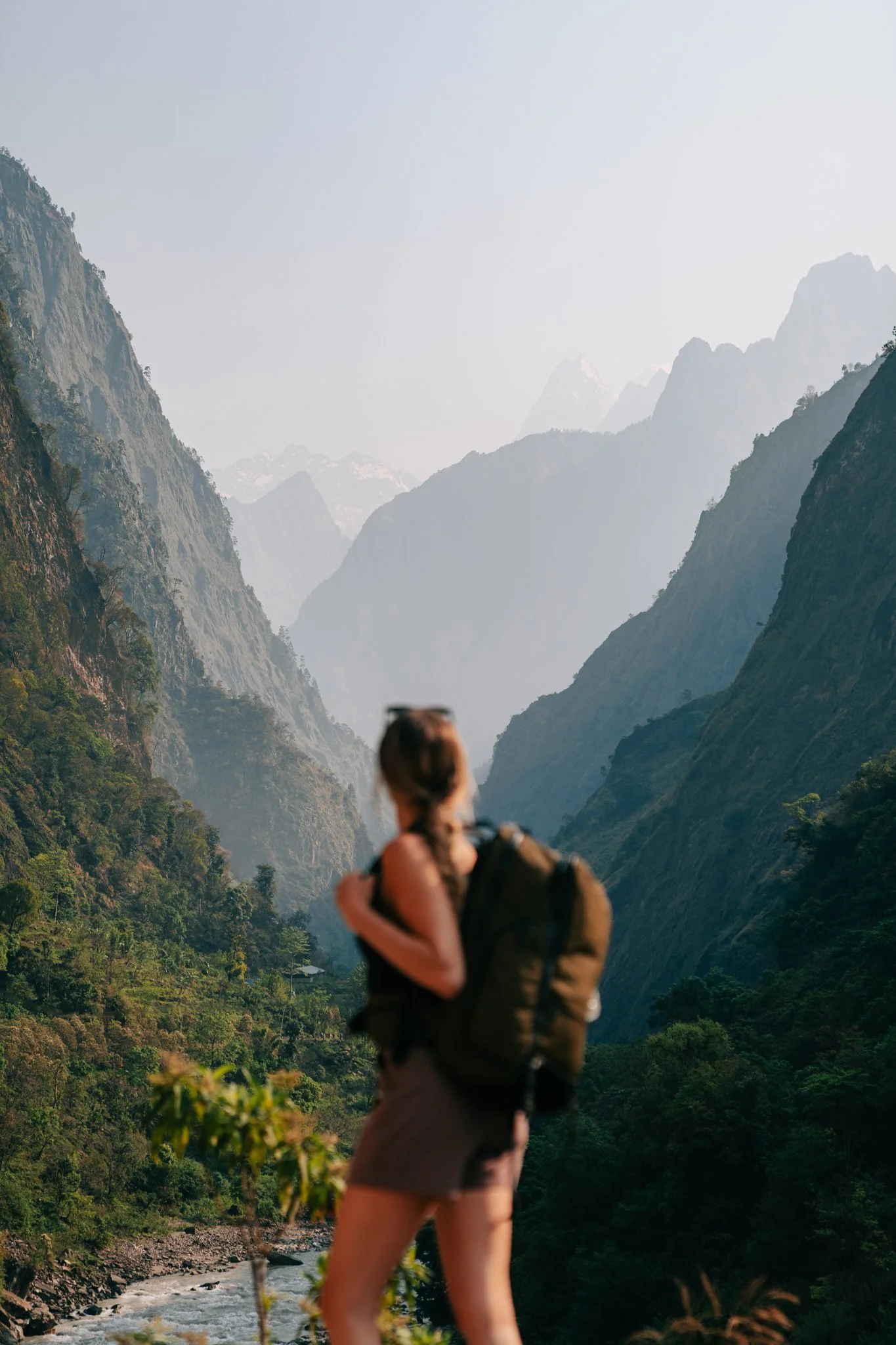
By day five I had walked myself onto a high alpine plateau above the village of Shyala, alone except for my guide, headed toward an abandoned monastery called Pungyen Gompa.
It was foggy. It was raining. I was wearing a $400 Arc'teryx jacket layered under a $1.50 transparent plastic poncho I'd bought from a roadside bodega, because the Arc'teryx wasn't long enough to cover my pants and pack. This is the kind of compromise this trek will force you into.
The plateau is so big and so empty that it does something strange to your sense of scale. When I looked up at the breaks in the cloud cover, I expected to see blue sky through the gaps. Instead I saw more mountain. The peaks above me were taller than the clouds. I was standing in the foreground of something I could not even fully perceive.
I had multiple breakdowns this day. Not noisy ones. Just standing in the middle of the trail crying for thirty seconds at a time, then walking again. It wasn't sadness. It wasn't fear. It was the feeling of being absolutely, vanishingly small in front of something old enough and big enough that none of my human worry mattered to it.
The Tibetan prayer flags strung from the surrounding peaks down to the monastery looked like a giant spider's web in the fog. Avalanches and rockslides boomed across the basin every five minutes — Jiwan kept reassuring me we were safe, but the sound itself reorganizes you. The Himalayas in spring are warming up, the snow is melting, the rock is loosening. The whole landscape is in motion under its own weight.
Jiwan told me, on this day, about Beyul Kyimolung — the Hidden Valley of Happiness. The legend goes that Guru Rinpoche identified and blessed eight sacred hidden valleys of the Himalayas more than 1,200 years ago, and this is one of them. The valleys are said to be guarded by deities who appear as snowstorms, mists, and snow leopards. The deeper you walk in, the more wild animals lose their fear of humans.
I am not Buddhist. I do not pretend to understand any of this in the way a person from that tradition would. But standing in the fog at 4,000 meters with no other humans around, hearing avalanches in the distance, the legend felt very plausible to me. Some places are just thinner than others. The full geography of this day — Shyala to Pungyen Gompa and back, what to look for, what to skip — is mapped out in the day-by-day itinerary.
The Toenails, the Cow, and Saga Dawa: Day 6–7
Somewhere around day six the small accumulated suffering of the trek caught up to my body. My hiking boots, which I had loved, turned out to be half a size too small. My toenails on the downhills had been getting steadily worse since day three. By the time we reached the village of Samdo, I knew I was going to lose two of them. I just kept walking.
This is the trek for a thousand small humiliations. The body wipes you brought because the showers are unreliable. The propane heater that ignites inside the shower stall like a gas stove and makes you stand under hot water hoping nothing explodes. The squat toilet in the same room as the shower. The wood-burning stove in the teahouse common room that everyone clusters around because there is no other heat source for miles.
It is also, somehow, the trek for moments of pure absurd comedy. In Samdo I sat at a window for three hours watching a cow lose her baby calf to a village man who carried it off down the lane. The mother walked the entire village mooing into doorways looking for her child. I was incandescent with rage. I was sitting at a window seething. They better bring this damn baby back. I went to bed not knowing if she ever did.
And then, on the morning of day seven, I woke up to a knock on my door from Jiwan and a sky so blue and so clear that I literally cried in the dirt courtyard.
It turned out to be Saga Dawa, the holiest day in Tibetan Buddhism. It celebrates the Buddha's birth, enlightenment, and death — which according to tradition all happened on the same full moon — and every good deed performed during the month of Saga Dawa is said to carry a thousand times the merit. Samdo is the closest the Manaslu Circuit gets to the Tibetan border, and the village is ethnically Tibetan, which meant I had accidentally walked into the most spiritually significant day of the year, in the most spiritually significant village on the route.
Jiwan asked the village if we could stay and observe. They said yes. They draped me in a khata — the white ceremonial scarf given to honored guests — and brought me into the headman's home. I was served Tibetan butter tea, dried fruit, and roasted barley flour called tsampa. I was taught how to take a palmful of tsampa in my right hand and throw it into the wind as an offering. I stood in a communal chanting hall while the men of the village sang religious songs and the women served tea and watched the children. The kids, fascinated by my broken Sony camera, came over to investigate the clicking shutter and tried to take photos of their own. I let them.
Then came the horse race. Then the archery competition, won by a man named Tsering, whose name in Tibetan means "long life." Then the moment when the village's young people sat around a giant wooden board hand-rolling momo dough, filling it with foraged greens and high-altitude potato and shallots and garlic, and steaming it in baskets stacked four high. Almost every ingredient grew within view of where we sat.
Standing in that hall in the white khata I was given, I had a thought I have not been able to shake. This is what holidays look like everywhere in the world. Families dressed up. Grandmas taking photos of grandkids on their phones. People wanting to remember things. The instinct is identical. Only the costume is different.
I left Samdo that afternoon and climbed to a stone shelter called Dharamsala at 4,460 meters. There is almost 50% less oxygen up there than at sea level. There is no Wi-Fi, no power, and very little reason to be there except as a launchpad for the pass the next morning. I shared a hut with a Dutch woman who had just quit her teaching job to do van life, and an Israeli couple who exchanged about six words with me.
That night I had a dream that I was suffocating. I was trying to call for help but nobody in the dream spoke my language. I woke up gasping, sitting up in the dark, clawing at the layers around my neck, surrounded by sleeping strangers, completely unable to move.
I had not realized, until that moment, how thin the air really was.
The Top: 7:22 a.m., Day 8
We left Dharamsala at 4 a.m. on May 4 with headlamps on. The fog from the night before had completely cleared and the moon was bouncing off the surrounding mountains so brightly that I set up my tripod and took long exposures of a basin that looked like daylight.
I cruised. I passed every other trekker on the trail. By 5 a.m. the early blue hour was lighting the peaks. By 5:30 the sun was up and gold. I was shooting some of the most beautiful photographs of my entire life on a camera with a shattered screen and a single lens.
The climb itself was brutal. I walked slower on the inclines than I had walked anywhere on the trek. My legs were shaking after every five steps. I had to stop constantly. But I kept moving. I kept telling myself the same thing, over and over: It's supposed to be hard. If it was easy, more people would do this. I came here for it to be hard.
I reached the top — Larkya La Pass, 5,106 meters — at 7:22 a.m.
I started crying the moment I could see the prayer flags. Something I had been holding in for four days came up all at once.
I am alone. I did this by myself. I wasn't sure I was the kind of person who could do something this hard. I never imagined I would even try.
The prayer flags and the sign at the top felt like permission to stop. Permission to look around. Permission to feel proud of myself. The summit was full of other trekkers, all of us clustered up there together, taking turns photographing each other in front of the flags. Everyone was happy. I was so happy to see other people happy.
I stood there with Das, who had carried my main bag for the entire trek, and I had a thought I have not been able to let go of either. You can do all the preparing you want. You can buy the $400 Arc'teryx jacket and the fancy sleeping bag liner and the boots and the spikes. You can sleep in a tent in your living room. Meanwhile, these porters are born in the mountains. They carry five times what you carry. They wear Air Force Ones. They don't spend a single second complaining.
I tipped my porter generously. You cannot pay them enough.
And then I noticed something. The broken camera didn't matter anymore. The helicopter didn't matter anymore. The toenails didn't matter, the boots didn't matter, the panic attack in the dark didn't matter, the rain didn't matter, the fog didn't matter, the seething rage about a cow I had never met didn't matter. None of it mattered.
I had done a hard thing. The hard thing was over. The hard thing had also turned out to not be a hard thing — it had turned out to be a series of small ordinary moments, walked one after the other, until I was somewhere I had never imagined I'd be.
After the Pass
The descent off Larkya La is long and snowy and brutal on your knees. I did not put my crampons on soon enough. I slipped, I took out my guide on the way down, I finally pulled them out of my bag. Das, who is otherwise the most serious porter you will meet, slid down a long stretch of the snowfield on his butt and carved a perfect groove that I gleefully followed for several minutes.
That afternoon we descended into a village called Bimthang where the fog cleared for the first time in days, just before sunset, and I finally saw Manaslu and the surrounding peaks unobstructed. They were the reason I came. They were absurd.
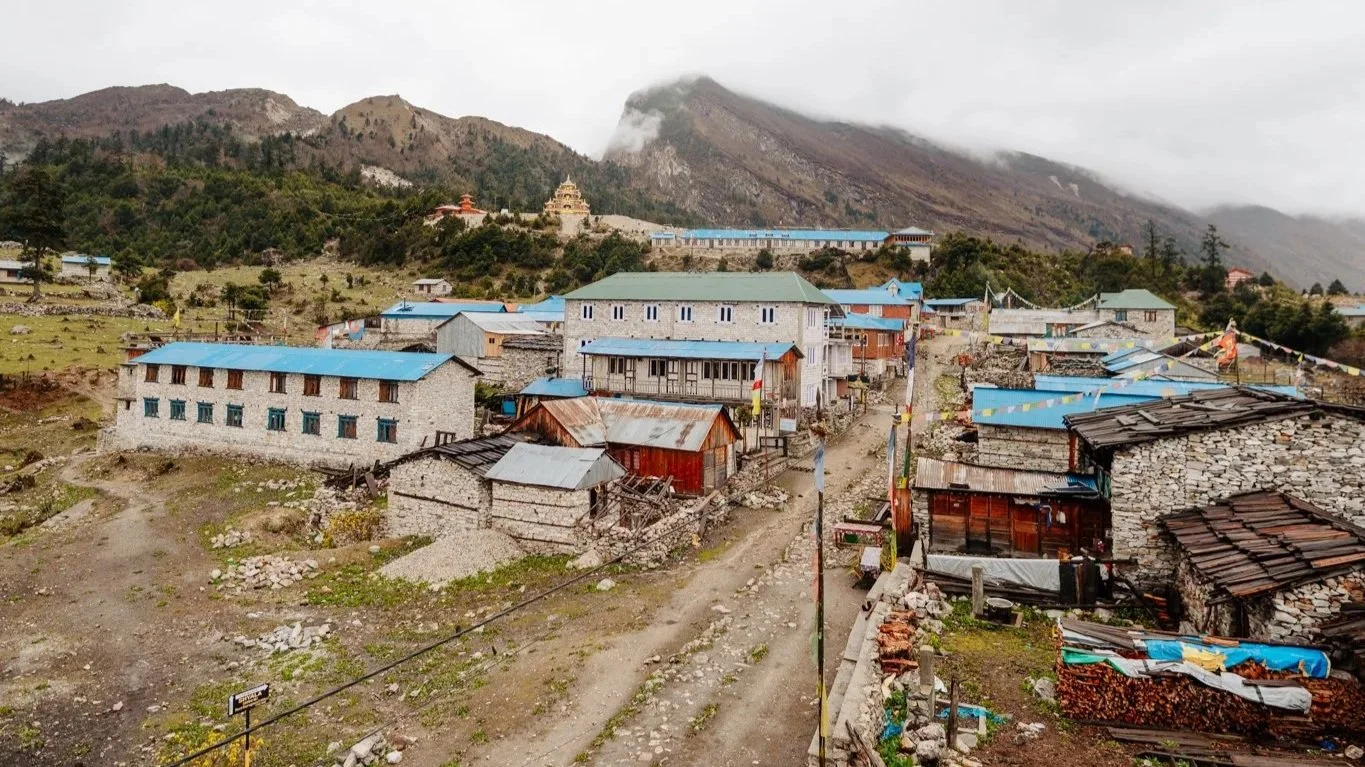
The next day we walked out of the mountains and back into a town with cars, and the day after that I was back in Kathmandu, taking the best shower of my life. Jiwan remembered I had mentioned loving yogurt on the trail. He stopped at a rural village on his way to meet us in the city and brought two enormous clay pots of homemade Nepali yogurt to the café where I was sitting. Each pot was the size of a half-gallon ice cream tub. We laughed so hard. He took us to his noodle factory, where his wife and daughter and father all sat with us for two hours on the floor of his apartment above the warehouse, eating popcorn and reminiscing about the trek in the rain.
That was how this trip ended. Not with a summit. With popcorn and yogurt and a stranger's family who had become, somehow, mine for ten days. The full descent and Kathmandu wrap-up, day by day, is in the day-by-day itinerary if you want the play-by-play.
Who This Trek Is For
The Manaslu Circuit is for you if you want the version of Nepal that has not been smoothed flat by mass tourism. If you want the Tibetan-influenced villages, the high-alpine plateaus, the seventh-century monasteries built into cliff faces, and the genuine cultural depth that comes with hiking through a restricted region where guides are required and group sizes are small.
It is for you if you are willing to be uncomfortable. The teahouses are basic. The food repeats. The showers are rare. The altitude is unforgiving. The trail is long. The weather will not always cooperate.
It is for you if you are interested in walking around a mountain instead of trying to summit one. Climbing Manaslu itself is more technically difficult than climbing Everest, and very few people attempt it each year. The trek is the saner cousin: still hard, still high, still wild, but designed for hikers who have never been to altitude before.
It is not for you if you want the Instagram version of the Himalayas. It is not for you if you need reliable Wi-Fi or hot showers every night. It is not for you if you cannot handle being meaningfully alone with your own brain for ten consecutive days.
If you are torn between this trek and Everest Base Camp or the Annapurna Circuit, I wrote a full side-by-side comparison: Manaslu Circuit vs. Everest Base Camp vs. Annapurna: Which Nepal Trek Is Right for You? If you've already landed on Manaslu and you're ready to make it real, the step-by-step booking guide walks through permits, agencies, insurance, and the exact "ask for Jiwan and Das" referral.
Honest Questions, Honest Answers
How hard is this trek, really?
Physically, it is hard. 87 miles, almost 24,000 feet of cumulative elevation gain, and a single 5,106-meter pass crossing on day eight. I was a former college athlete and naturally fit, and I still struggled with the altitude. The hardest part is not the cardio — it is the mental endurance of doing the same thing every day for ten days at increasingly thin air.
I broke it down day-by-day in my full itinerary post: Manaslu Circuit Trek: An Honest 10-Day Itinerary from a Solo Female Trekker.
What should I actually pack?
The short version: layers, a thermal sleeping bag liner, broken-in boots a half size larger than you think you need, body wipes, sunscreen, and twice as many downloaded podcasts as you think you will need. The long version, including what worked and what failed for me as a photographer carrying camera gear at altitude, is in my full packing guide: Manaslu Circuit Trek Packing List: A Photographer's Edition.
How do I actually book this trek?
You cannot do the Manaslu Circuit independently. It is a restricted area, and Nepalese law requires a licensed guide and a minimum of two trekkers in the party. The full breakdown of what to look for in a tour operator, how the permits work, what insurance actually covers, and how I chose my company is in my booking guide: How to Actually Book the Manaslu Circuit Trek.
Is this the right trek for me, specifically?
If you are still deciding between this trek and the other big Nepal options, I wrote the post I wish I'd had: Manaslu Circuit vs. Everest Base Camp vs. Annapurna: Which Nepal Trek Is Right for You?
Could I do this as a solo female trekker?
You will not be solo in the strictest sense, because guides are required. But yes, I did this trip after my travel companion got helicoptered out, and I felt safe and supported every single day with my guides. The community on the trail — Australians, Brits, Israelis, the occasional American — is full of solo female trekkers, and the teahouse common rooms become genuine small communities every evening. If anything, the restricted-area requirement makes this trek safer for solo female travelers than its better-known cousins.
Final Verdict
The Manaslu Circuit Trek is the most physically and emotionally demanding thing I have done. It is also, without exception, the trip I would recommend most strongly to someone trying to figure out what they are made of.
You will lose things on this trek. Maybe a camera. Maybe a friend, temporarily, to a helicopter. Maybe a couple of toenails. Maybe the version of yourself that was not sure she could do something this hard.
What you will gain is a kind of quiet that I have not been able to find anywhere else. A high-altitude pass at sunrise. A village welcoming you into the holiest day of their year. Two guides who, by the end of ten days, feel like family. And the certainty, going forward, that you have done a hard thing and survived it well.
Go.
Ready to book?
Book the Manaslu Circuit with Ecuatraveling
When you book, ask for Jiwan and Das by name — and tell them Karlie sent you. They are the entire experience.
Book the Trek →Want the full breakdown before you commit? Read the step-by-step booking guide first.
If this post helped you, the best thing you can do is forward it to one person who might also need to go.
— K.