Photography Guide to Doha, Qatar: The Best Photo Spots in the City (and Desert)

Because Doha Doesn't Just Deserve a Travel Guide — It Deserves a Whole Lens.
When I stepped off my Qatar Airways flight into Hamad International Airport, I had a feeling Doha was going to be one of those cities that stops you mid-stride. The kind of place where you're constantly putting the camera down just to stare — and then immediately raising it back up because there is no way you're leaving without a photo of that.
This post is for the photographers, the content creators, and the visually obsessed travelers who want more than a map pin. This is everything I know about where, when, and how to shoot Doha — pulled from my own trip through this extraordinary country on a visit supported by Qatar Tourism. I'm sharing the exact locations, lighting tips, and timing advice I wish I'd had before I landed.
Let's get into it.

1. The National Museum of Qatar: An Architect's Dream and a Photographer's Playground
I'm going to be honest: I didn't expect the outside of the National Museum of Qatar to be the thing that floored me. But the building designed by Jean Nouvel — inspired by the structure of a desert rose crystal — is one of the most photogenic pieces of architecture I've ever put in front of a lens.
The exterior is a series of interlocking discs spanning 430,000 square feet, clad in sand-colored concrete panels that shift and change depending on where the sun is sitting. In the morning, the shadows fall in long diagonal lines across the discs. By midday, the whole thing glows. At golden hour, it turns amber and almost looks like it's on fire.
What to shoot: The disc-on-disc geometry creates endless layering opportunities — especially from a low angle looking up. Move around the perimeter and you'll find that the building transforms completely every 20 meters.
Best light: Early morning or late afternoon. The sand-colored concrete absorbs warm light beautifully.
Practical note: Book tickets online in advance to skip the queues, and give yourself at least 3 hours.
2. Katara Cultural Village: Come at Sunrise, Thank Me Later
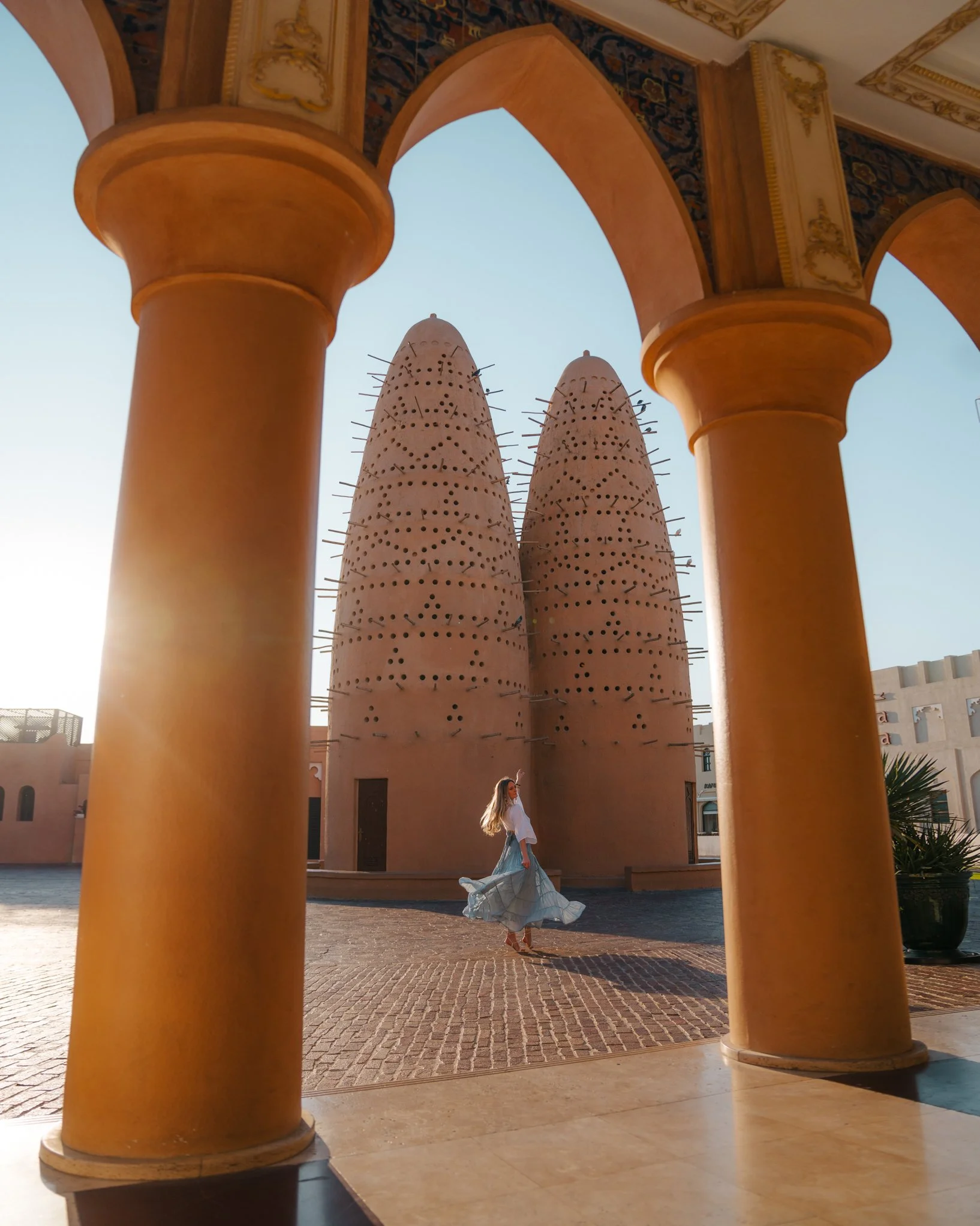
Katara Cultural Village is Qatar's largest cultural hub — a sweeping complex of amphitheaters, traditional architecture, art installations, and heritage buildings. During the day, it's vibrant and lively. But if you come at sunrise, it's something else entirely.
The buildings take on a golden hue when the first light hits — there's a warmth to the whole place that simply doesn't exist once the sun climbs higher. By mid-morning it gets busy, and the light gets harsh. Show up early, and you'll have those ornate walkways almost entirely to yourself.
What to shoot: The amphitheater, the arched walkways, and the domed buildings are all incredibly photogenic. Look for the geometric tilework and the interplay between shadow and warm light on the stone facades.
Best light: Golden hour at sunrise is the move. I cannot stress this enough. Come early.

3. Doha Corniche at Golden Hour: The Skyline Shot Everyone Needs
The Doha Corniche is a 4-mile waterfront promenade along the Arabian Gulf, and it delivers one of the most dramatic city skylines I've photographed anywhere. The futuristic towers of the West Bay district rise up across the water — glass and steel catching light in a way that's almost cinematic.
For sunrise: The Corniche faces east-ish, and when the first light hits those towers, they absolutely glow. I was out there for a morning walk and ended up shooting for 45 minutes without meaning to.
For evenings: The locals know what's up — they come out for evening strolls when the temperature drops, and when those towers light up against a purple-to-navy sky, you've got pure magic.
What to shoot: Wide establishing shots of the skyline, reflections on calm water, and compression shots that make the towers feel impossibly tall. A longer lens (70-200mm equivalent) lets you pull those buildings in beautifully.
4. Souq Waqif After Dark: Texture, Color, and Spice
The Souq Waqif doesn't wake up until the sun goes down — and that's exactly when it becomes one of the most photographically rich environments in Doha. Located on Al Souq Street, this historic marketplace fills with the smell of incense and spices, and the narrow lanes glow under warm amber lighting.
The textures here are extraordinary: woven textiles, patterned lanterns, mountains of saffron, stacked pottery. I found myself negotiating for traditional handicrafts — which, by the way, you're expected to do — and simultaneously trying to frame shots of the whole beautiful chaos.
What to shoot: The market at night has an almost dreamlike quality — try slower shutter speeds to capture the motion of people moving through the souk, or use a higher ISO and faster shutter to freeze the candid moments. The spice stalls are an incredible burst of color in an otherwise warm-toned environment.
Best light: After sunset. The artificial lighting gives the whole place an incredibly warm, golden quality — and there's enough of it to shoot handheld if your camera handles high ISO well.

5. Mina District: Pastels, Port Vibes, and Instagram Corners
The Mina District used to be Doha's working port. Now it's one of the most photogenic neighborhoods in the city — a maze of pastel-colored buildings that house boutiques, cafes, and art galleries.
I spent an afternoon here just wandering, and I was constantly surprised by what was around the next corner. Mint green walls with bougainvillea. Turquoise shutters against dusty rose plaster. Murals. Old wooden doors. It's the kind of neighborhood that rewards slow exploration with a camera in hand.
What to shoot: Architectural details, color blocking, storefronts, and street portraits if you can get permission. The late afternoon light hits the west-facing facades beautifully, turning the pastels even softer and more dreamy.
Best light: Late afternoon into early evening.

6. The Desert at Khor Al-Adaid: Sunset Over the Inland Sea
This one is not technically in Doha — but it is absolutely non-negotiable for any photographer visiting Qatar. The Inland Sea at Khor Al-Adaid is where desert meets the Arabian Gulf, and the dune bashing that gets you there is half the experience.
I booked through Qatar International Adventures, and they arranged a full afternoon into evening experience — dune bashing in 4WDs, time at the Inland Sea, and a traditional Bedouin-style dinner under the stars. Book the afternoon tour specifically so you arrive at the Inland Sea around golden hour. The light on the dunes at that moment — the shadows, the depth, the gold — is genuinely unlike anything I've ever photographed.
What to shoot: The ridgelines of the dunes, the contrast between sand and water where the desert meets the sea, silhouettes at sunset, and the massive scale of the landscape from a high dune.
Drone note: Check current Qatar CAA regulations for drone flight before your trip. Rules can change, and it's always worth verifying ahead of time.
You can book a desert safari with dune bashing through GetYourGuide here — this is an easy way to arrange everything without having to coordinate independently.

7. Museum of Islamic Art: Architecture That Earns Its Own Section
The Museum of Islamic Art is I.M. Pei's final masterwork, and it sits on its own artificial island — which means you have incredible options for exterior photography without buildings crowding your frame. The five-story limestone structure combines modern geometric design with traditional Islamic architecture, and there's an oculus that captures and reflects sunlight throughout the day in stunning ways.
What to shoot: The exterior from the waterfront — the building reflects beautifully when the water is calm. Inside, the central domed atrium and the way light moves through the oculus creates constantly changing shot opportunities.
Best light: Morning for exterior, midday for the interior oculus light at its most dramatic.
Photography Timing Guide: When to Shoot What
Time of DayBest LocationsWhySunrise (6–7:30am)Katara Cultural Village, Doha CornicheGolden buildings, empty streets, soft warm light on the skylineMorning (8–11am)National Museum of Qatar, Museum of Islamic Art exteriorDefined shadows on architecture, before the harsh midday lightMidday (11am–2pm)Museum of Islamic Art interiorThe oculus light is at its strongest — dramatic interior shotsAfternoon (3–5pm)Mina District, National MuseumSofter directional light on pastel facades and sand-colored concreteGolden Hour / SunsetKhor Al-Adaid Desert, Doha CornicheDunes on fire, skyline reflections on the GulfNight (after 8pm)Souq Waqif, Doha Corniche (lit skyline)Warm ambient light, the souk comes alive, towers illuminate
My Camera Gear for This Trip
Qatar throws a lot at your camera — intricate architectural details, sweeping desert landscapes, dark souq interiors, and dazzling nighttime skylines. Here's what was in my bag and what I'd bring again:
A few highlights: I relied heavily on the Sony a7 IV for all the architecture and landscape work. The Sony FE 14mm f/1.8 GM was incredible for shooting the MIA interior and the disc architecture at the National Museum — wide and sharp. And the DJI Mini 5 Pro came out for the desert (check local regulations before flying).
Practical Notes for Photographers in Doha
Best time to visit: November through March gives you the most comfortable shooting conditions. I went in November — it was warm but manageable, and the quality of light in that season is beautiful. Summer months bring extreme heat that can make extended outdoor shooting difficult.
Getting around: Uber is widely available in Doha and very affordable. For the desert excursion to Khor Al-Adaid, I'd recommend booking through an organized tour operator rather than attempting it independently.
Dress code: Pack modest clothing for cultural sites like Katara and the museums. At hotels and beach clubs, normal resort wear is fine.
Memory cards: Bring more than you think you need. Qatar has a way of filling them faster than expected.
Ready to See More?
This photography guide is a deep dive into a small part of what Qatar offers. For the full picture — including where to stay, what to eat, and the full itinerary that took me through all 15 locations — head over to my complete Qatar guide: Ultimate Guide to Qatar: 15 Must-Visit Destinations for Luxury and Culture.
And if you want to book a desert safari with dune bashing to catch that sunset at Khor Al-Adaid, you can find tours through GetYourGuide here.
This post contains affiliate links. Booking through my links supports this blog at no extra cost to you.